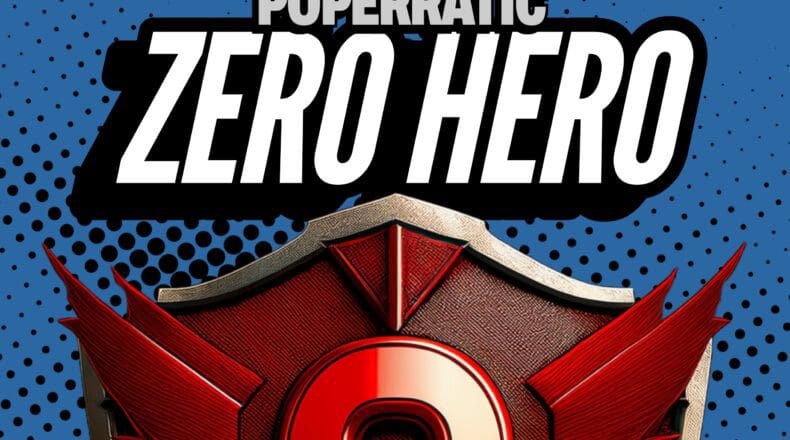
I’ve seen comments online accusing my music video, “Zero Hero,” of being AI-generated. They don’t just claim that I used it for a little help. They’re insisting the video is 100% generated with machine learning. Normally, I wouldn’t bother to dignify this kind of thing. I figure most of my genuine audience knows how much care I put into every musical note, word choice, line of code, and pixel I produce. And I believe anyone whose unfamiliar with me but who has even the slightest understanding of film (or AI itself) would be able to understand that only a human being could make it. The consistency of the narrative and the logistical complexity of most scenes should be evident, even if someone doesn’t possess the hands-on experience to conceive that this work of art translates into hundreds of hours of manual labor.
And, no, AI didn’t create this essay either.
I don’t feel particularly impacted by the accusation. I’m not in the demographic of someone who typically benefits in a significant way from being online, no matter the quality and effort of the work. There’s very few people online who would write me off based on an accusation, who weren’t already doing so or poised to do so. It’s why the video was created for offline venues in the first place. For the effort, the video was cited as an official selection, earned nominations and awards at a number of film festivals worldwide. Not life-changing but satisfying to have something I put that much time and heart into not treated as random content that’s made everyday.
I would care very little if I learned that someone decided to boycott me on a suspicion of something I didn’t do. They’re welcome to enjoy a wide array of homogenous creations that are easier to analyze and accept. I’m now at a stage of life where I’ve long since accepted that one can become a supervillain in a lot of circles today simply by being kind and self-motivated, so I’d take it as another badge of honor, frankly.
I’m simply expressing a weariness of what society has become and a warning of where else history has shown us it will lead.
The modern culture has conditioned a lot of people to believe everything and everyone should fit into a neat box of conformity and predictability. Anyone who demonstrates that they are capable of being resourceful outside of the “way everybody else does it”, or skilled or knowledgeable in more than one domain…or a work of art that is highly stylized and sometimes surreal or avant-garde must not be legitimate. It must be a lie. This type of defiance dispels narrow, curated worldviews. When anyone or anything deviates from the norm, or from a person’s own overconfident but limited exposure to a broader range of information and concepts, people become fearful, insecure, threatened, and/or skeptical. The immediate reaction is to dismiss or undermine.
At present, AI McCarthyism is where this sort of behavior frequently manifests. It began as legitimate and well-meaning expressions of concern regarding the rapid scaling of data scraping in commercial artificial intelligence. But it’s quickly devolved into an internet bandwagon of targeted accusations that are frequently vague and wrong but always aim to discredit and sow distrust in other people’s knowledge, processes, and integrity. As it was with Senator Joe McCarthy’s 1950s Red Scare, there usually is no evidence and mobs hungry for something or someone else to hate don’t require any.
These false accusations around my video inspire me to share thoughts on AI McCarthyism that I’ve been sitting on for few years. It’s important for me to do so now because many people now view, judge, and/or dismiss artistic creations and any other thoughtful expressions the same as any formulaic content that pops into their feeds. Some then go much further and turn theories into potentially damaging facts without ever asking the accused.
This isn’t the first time AI McCarthyism has reared its head for me or thousands of other people. It echoes the mid-century witch hunts where blacklists and pure suspicion destroyed many careers without a shred of evidence. In this case, the current political landscape, economy, and workforce are doing more to interrupt and dismantle careers. However, at the very least, AI McCarthyism can damage to a reputation and cause questioning of a person’s ethics or morality simply by invoking an accusation. This is a dangerous precedent to embrace, as we’ve been down this road before.
I’ve been accused of using AI for creative works (usually visual and writing) and even blatantly absurd things like YouTube comments. Simply because some people think you should only possess skills and knowledge in the one area that they were introduced to you through. Or a person shouldn’t have knowledge about things that the viewer themselves had no prior experience with. So, I’ve got some things to say.
When I began to think of this form of targeting in the context of McCarthy in that context, it shifted my view on AI. Even though I had a lot of knowledge and experience with the technology for quite some time, there was a brief period in which I started to shy away from it. I stopped accepting work that was directly related to AI prompting, I stopped sharing my experiments with people, then stopped using products like ChatGPT, Gemini, Claude, and so on. It wasn’t even a conscious decision. I think I started to see this “backlash” and figured, “Okay. People are starting to push back and they’re going to stop using all these AI services so that there can be more ethical changes across all industries. Then, we’ll all experience the true promise of artificial intelligence.”
But that didn’t happen. It just turned into witch hunting. They’re still using the services, and that’s where the witch hunting is taking place. As for me, humans didn’t step up to fill any voids. I went right back to being underemployed and everything it entails with very few people willing to help with referrals or otherwise helping me reach more people. It became clear that, for most people, this isn’t about wanting change. It’s not a pro-human cause. It’s simply an anti-“whatever I don’t believe benefits me” cause. It’s about wanting to police people, wanting to stop things that are unfamiliar, and for those who aren’t early adopters to slow the train until they can catch up.
Being a technically savvy person, I’ve naturally followed developments in AI for decades. I’ve toyed with generators, filters, and entertainment apps, including from independent developers. I’ve attended webcasts and on-site symposiums. I’ve built and configured internal chatbots trained on my own data, managed bots in employment environments, and tutored others in prompting.
What I have not ever done, though, is run prompts for creative projects, upload the results, dust off my hands, and pass it off as though I magically created that thing. I’ve always been a person who learns by doing. Even if I don’t have everything I want or need. Even if I make mistakes. Even if other people don’t believe one person can or should do it.
Many people seem to get hung up on the user-friendly interfaces that have been mass-marketed. The ChatGPTs, Geminis, and Claudes of the world. And these are the blanket “evil AI” that people assign to everything.
But artificial intelligence appears in many formats and is not always something that is prompted. It is sometimes working in the background of things we use everyday. It’s similar to the way that the graphical user interface of a device’s operating system masks the execution of code happening on the lowest levels of that device every time one clicks on or type anything. Programs. Algorithms. Instructions the computer follows. It makes it user-friendly and ensures that we don’t all have to become experts in CLI or Terminal commands to do all the things we now take for granted.
With that in mind, I use AI regularly and consciously. And so does most everyone else. The technology is in nearly every device, every production and productivity app, in addition to the well-known bot brand interfaces.
I mainly use it for personal and business tasks that allow me free up more of my time to be creative. When I use it intentionally, it’s a pre-production or a post-production tool for tasks that would normally be tedious, repetitive, and decidedly uncreative. And for tasks that I’ve repeatedly asked other human beings for help with to no avail.
My position has always been that if a person isn’t willing to share a community or resources with others, they don’t get to tell them if, how, and when they can circumvent someone else. This is true of anything that is neglected, ignored, or gatekept, but it now extends to the conversation around artificial intelligence.
A person using AI for produtictivity tasks is no more complicit in the closure of factories, the growth of deepfakes, or theft of art than feeding algorithms with hypocritical opinions all day long on Instagram, Facebook, Twitter/X etc.
For instance, I’ve known visual artists who complain all day long about “AI theft” and criticizing others for supposedly contributing to this. They can still be seen posting all of their detailed artwork and tutorials online daily, to hold attention and grow a following. People feeding algorithms with more data regularly also do not seem particularly outraged about suppression of accounts smaller than their own, repeat layoffs, difficulty getting humans to read cover letters and job applications, and credit scores that don’t align with how credit has been managed. Those are things that I’ve personally experienced that are connected to human beings’ over-reliance on AI, and which have had real-world consequences.
The difference is that I know all of these things are connected to human behavior rather than the technology itself. We’ll get into ethics in a bit.
There’s a huge difference between talking about the impact of AI in the workforce in terms of the rapid scaling of physical automation vs. talking about AI as a tool for individual resourcefulness and productivity, and leveling playing fields. All of these things are true at once: some humans use AI in ways that hurt people, some people use AI without knowing or admitting they do, and some humans use AI to help people. I’m in the latter camp and I support other people who are in the latter camp.
For every door and opportunity that is blocked by AI usage under a corporation’s or popular account’s control, in the individual’s hands, AI assistance can be a tool to bypass gatekeeping and execute more complex ideas without a large budget. The human can remain the exclusive author and director, clearing out tedious hurdles and making way for the imagination. That doesn’t always mean using AI-equipped tools to create any actual work. For some people it is but, for me, it’s a pre-production tool.
My creative work is the main thing that keeps me leaping out of bed every morning. I’m a problem-solver and I love figuring out how things work and how to make things work with what I have. Even if it takes some time. I don’t have a shortage of ideas or a shortage of skills.
My problem is usually a shortage of resources, and manpower for all I’d like to do and support to raise awareness for more opportunities to get more resources. But once I start a project and have some idea of how I’m going to execute it, I get tunnel vision. I’m restless and want to devote every waking hour I can to that thing until I feel it’s finished.
“Zero Hero” was very much one of those things. I didn’t know exactly how I was going to pull off everything, but I couldn’t stop once I started. I obviously already had the narrative of the song to work with, but created an outline of the more layered aspects of the visual narrative. There was a lot of troubleshooting and problem-solving along the way as new ideas and new limitations popped up and I built much of the video as though completing a puzzle. It wasn’t completed chronologically, but each section and transition constructed as the ideas came.
That is one of the things that makes this type of production so fun for me. It hasn’t ever crossed my mind to think, “I don’t feel like being creative. How can I can spend less time on this? I don’t feel like trying to learn something new even if it doesn’t work out the way I’d like. Lemme type these ideas and let a bot make this video for me and hope it’s matches what I’m trying to express in both the song and video concept.”
I respect that if other people choose to use AI generation to any extent, it’s their choice. And they can choose to do so for any reason–self-empowerment, curiosity, fun, experimentation. Their art does not belong to me. Frankly, a private citizen playing with or designing apps to make something that makes them happy is not a threat to me or my work. I know my own capabilities, my thinking, my perspectives, my processes and it doesn’t interfere with my own choice to display all of it in artistic acts. Even when I myself use AI technology for my own purposes, my brain and my hands are still used on everything I do and reflects my own creative thinking and skillset.
It doesn’t take long to research my background and see a long history of using multiple disciplines and showcasing person skills the mainstream never utilizes. Furthermore, anyone has the capacity to use decades-old techniques like to pull off visual trickery. Similar techniques that my audience has seen in other work I did 20 years ago. Nothing groundbreaking was done in “Zero Hero”. Brainpower and individuality were the main tools I used in making the video:
Creative human being with animation, film, graphic design, coding, music, sound design, acting, writing, and concepting experience + MacBook Pro + 2D Animation + Adobe Creative Suite (Photoshop, Character Animator, After Effects) + a few licensed 3D assets + Keyframing + Motion Capture + Character Rigging + Compositing + Masking + Multiple Editing Workstations + several months of all nighters and shitloads of coffee + draft feedback (including from professional studio animators) + 4 subsequent revised and expanded cuts.
In other words, there were no prompts. A human being had thoughts and processes. And that human being even consulted other human beings and incorporated most of their feedback about the timing, camera angles, and more. It translates in to an estimated 800-1,200 hours of my own labor from pre-production to lock picture.
To look at the result of all of that deeply human effort and dismiss it as machine-made is disrespectful. It also shows ignorance of the processes that go into making a craft. Just because that accuser doesn’t use the same processes and techniques, doesn’t have the same influences and inspirations, doesn’t have the same manpower or resource limitations, doesn’t mean that it is another person’s reality. Therefore, it doesn’t mean that what they produce is going to automatically look exactly like what the accuser makes or what anyone else is making. Or even dissimilar to it. Even if we’ve seen a person’s past work, we also may not know what they’re studying and putting into practice now.
Since no major video or graphics production tool is entirely AI-free today, it’s highly likely that the human artists behind the few premium assets I licensed (a fraction of what’s seen) used AI assistance as their starting point.
All premium assets that I licensed were chosen for their aesthetics and potential for functionality with the narrative scenes I designed. They all clearly had some level of human artistry involved, and allowed me to put my few resources toward supporting other artists. I then reworked and integrated those assets using old-school techniques. Doing so added additional logistical complexity and does not erase or diminish the volume of handcrafted work I (or they) performed.
The dystopian “damsel-in-distress/train track” backdrop is the primary one that is likely stirring controversy because it’s surreal, stylized and has some jagged edges in the trees/telephone poles in the background. I licensed this still image from Adobe because the human artist behind it perfectly captured the dark surreal and nightmarish aesthetic, details, and perspective I wanted for the segments I used the image. It looked closer to the background in my head than what I managed to created myself. It allowed me to have a nice contrast for the darker parts of the story and lean into the train hero trope. I saw clear evidence that human hands still very clearly shaped it.
The entire “Zero Hero” project involved hundreds of hours and that’s all that I was allowing myself. I’m not wealthy and was never going to spend additional years sweating over a project I’m not earning money from and which will be lucky to get a few thousand views in its lifetime. I was making something purely to uplift and entertain the few people I could rely upon to watch it, and I poured every bit of myself into making sure it was visually interesting to them. I succeeded in that.
However, licensing a few assets for enhancement is still a far cry from claiming AI generated four minutes’ worth of specific scenes, character and camera movements, VFX, timing, and transitions. Or that I even had the resources to do so.
In fact, to speed things up on a $50 maximum budget, I even used techniques such as basic webcam motion capture. As I performed to the track in front of my computer, the characters’ arms, eyes, heads, and mouths reflected my own physical movements. It was an experimental and imperfect but a completely human process with cool results. Every scene required planning and attention to detail but some sections and actions required even more experimentation and problem-solving. With my own brain.
I did need AI help in one area, though. In the massive mission to adapt descriptive audio captions into more than 20 languages. This was additional human time spent, approximately another 100 hours from translation to manually creating SRT files and checking the sync and line formatting. Given that I’m not a polyglot but actually care about communication, accessibility and quality of communication, I used my own experience with language learning to push the AI to give better output.
It was me, the human, who understood that I needed guardrails to factor in cultural nuances and modern expressions. Phrases like “train of thought” and “A side of me is inside of me” cannot be directly translated in some languages, while still conveying artistic intent. I revised each language, section by section. Some translations are even more colorful, evocative, and poignant as a result. Some translations of simple phrases became sentence-length in another language so I had to factor that into formatting as well.
But, again, that’s different than saying the video itself was generated. I would love to know what generator/s my accusers think I used. Because it would be:
- amazing that any generator could do all of those sequences, in whole or part. Especially considering all the lip synching, dancing, levitation, explosions, lighting, superimposition, distance, multiple characters flying, unique transitions, etc.
- amazing that it could make something that looks so distinct, yet still tell a cohesive story
- hella expensive to generate four minutes’ worth.
- even more impressive if I were able to pull that off.
Each time I’ve been directly accused of using AI, there’s been some distinct patterns. It’s always someone who didn’t take the time to learn about my background, or someone who’s trying to diminish and dismiss what I do.
When people can’t wrap their heads around how one person can work across multiple disciplines, they find a convenient shortcut to make an accusation. Instead of asking questions, proposing a collaboration, or hiring me, they escalate to pure kookiness. This has even happened after leaving thoughtful or informative comments on YouTube videos. How dare I use punctuation or make factual points that make sense? A lot of people are just as insecure as they are downright strange.
I’m not interested in debating my integrity with random people on the internet. I do, however, take issue with the idea of planting these kinds of Red Scare seeds. In the case of “Zero Hero,” my work was placed on a list posted on a platform known for irresponsible and snarky people. The list was just a collection of names and a so-called film festival review.
This review consisted of a single line for each work assessing the likelihood of it being AI, followed by mostly trashing the ones the author deemed to be human-made. No evidence was given, and no specific suspicions were cited. Just an accusation and instant believers ready to destroy lives if they could.
Joe McCarthy would be proud.
People are raising perfectly valid questions around the ethics of AI. We have seen a lot of destructive consequences since AI has taken new forms over the past few years in particular. It’s happening in every sector. What I feel is getting lost, though, is nuance.
Many keep personifying artificial intelligence itself, which makes it easier to fear and scapegoat for the real problem. I always tell people that there is nothing to fear about AI. It is a technology and various types of technology have been useful in the advancements of the world. Artificial intelligence does nothing but execute tasks. The concern should be centered around who owns and builds AI technology, what parent tasks are they programming, who are their customers and what are they doing with the output?
Expressing that one is so fearful of AI that it’s necessary to avoid it at all costs is akin to saying that they fear Fred Flintstone and need to avoid all cartoons.
What people ought to say is that they fear when unethical people are the ones who are making decisions around it. The more the McCarthys are focused on shaming anyone they remotely suspect of AI use online, real damage is being done as AI is being used as an excuse for layoffs, underpayment, discrimination, profiling, scams, and an assortment of other ugliness.
Anyone who truly is interested in curbing such things should be writing to their local and state representatives. Any making sure they are voting for candidates who will place guardrails on how the tech is used when it comes to personal data, civil rights, credit, advertising, etc.
Now, a ton of companies have jumped on board this AI banning train because they’re afraid of alienating their user bases and don’t want to spend a ton of time fielding press relations and customer service nightmares from people who threaten to boycott them. Accountability is a good thing and making sure that services for and by humans retains that feel and trust is a good thing. If there were free reign to have full-blown AI productions, whether it be art, code, writing, video, or music, surely these spaces would be overwhelmed with more cheesy generic, lifeless work than any of us needs or wants to see.
But I notice that most companies making these policies are having trouble enforcing them or even understanding what they themselves actually mean when they say “NO AI”. Does it mean no prompting and uploading straight output as one’s own? Does it mean not using any form of AI assistance? Does it mean not using any tools or technology that implements AI at all?
Because those last two are where things get really interesting. If we’re talking about an absolute banning of all AI technology and things made with tools that contain AI, then we will likely no longer to be able to enjoy have 99% of what we read, watch, or listen to. It’s in the many of the tools people are using to create, revise and/or distribute. It’s in the tools being used to share and market to an audience.
Even though it’s been in use, in plain sight, for decades, active awareness of the technology is still new to most people. No amount of policing is going to be perfect, clear, and effective. Because there simply isn’t always a way to know who’s using the technology, when, how, or why. But rational minds know that just about everyone is except the Amish and handfuls of other people that aren’t reliant on technology.
This is why I argue the policing and witch hunting is pointless. It’s only making more people fear the act of creating and expressing themselves. People who own AI companies aren’t going anywhere. People who want to use what they’re making are going to use it and, unless everyone else is planning to move to an off-grid homestead, every other person will be using it in some form, too. Energies should be refocused on speaking to and joining those in positions of power to expand ethical behavior around how the technology is used.
When it comes to people simply creating things and the idea that we need to analyze, accuse, and shame anyone who is suspected of using AI, nuance is needed there as well. There should be room for us to accept that there are variations in skills, budgets, goals, or aesthetic preferences.
For example, a video may not have a perfectly homogeneous look because it was designed that way intentionally, or because it had to be assembled piecemeal due to real-world resource constraints. It might resemble an existing work because of homage, or specific influences the artist themselves embrace, or techniques they’ve spent years studying. None of these things means that AI was used.
A piece of writing may be error-free or sound articulate because the person is simply knowledgeable, experienced, and puts time and effort into expressing themselves. Not everyone is interested in blurting out every random thought that comes to them or sprinkling emojis into every piece of communication. Some, like myself, have been paid to write at times. Some know how to use punctuation in our native tongues. It is not a commentary on people for whom that’s not true.
Nowadays, anything stylized, coherent, error-free, and punching way above its budget weight is automatically a target. Because the skills displayed defy a narrow set belief, or they simply trigger the limited knowledge of the accuser. Other times, people target an artist out of petty rivalries, personal grudges, jealousy, insecurities, or a desire to enforce gatekeeping for their own reasons.
I am deeply pro-human and I prefer human-created art, naturally, but we have to be realistic about how technology fits into the picture. There should be some room for artists who use AI assistance, provided they’re still putting original thought into the work and not just uploading straight, unedited AI output. Most people don’t realize that for AI-assisted work to be good, it often requires a ton of work, creativity, and strategy. That was one of the original promises of the technology, and it’s how AI features have been used by most creatives for decades anyway.
The fallacy of demanding “NO AI anywhere at any time” realistically means that no work can exist unless it’s completely created analogue and only shared in person or via a limited amount of physical formats. I’ve observed that many arguments about AI are essentially about deciding which algorithmic shortcuts are “evil” and which ones are merely convenient.
Policing other people’s workflows while enjoying how machine assistance reduces effort in their own. If everyone who claims to be pro-human and anti-AI truly meant it, then they couldn’t even be online spewing those wild theories and opinions outside of HTML-only web pages. Or they would be following every rational human being’s account to give everyone an equal voice. But since this don’t, this would mean no social media for the puritans!
No one could use spellcheck or grammar checks, or autocomplete. No one could secure phones with FaceID or have anti-fraud on bank accounts. No spam filters. No recommendations on feeds or streams. No GPS navigation. No smartphones or smart TVs. No security systems. No collision avoidance, keyless entry or ABS. No robot vacuums. No Instagram filters.
Creatives would need to stop using all the automated features they’d been using for decades like snap-to-grid alignment, auto color and pitch correction, and quantization.
I, myself, would be cool with a massive solar flare rolling the technological clock back somewhat. I grew up before most of this was commonplace and am no stranger to making things purely from scratch or making an effort with traditional means otherwise. However, I’m willing to bet that, given a real choice, most modern McCarthys wouldn’t want an automation-free life or a life of pure manual labor.
What’s also not considered in the conversations surrounding this form of rigid gatekeeping is the complete exclusion of people who have accessibility challenges. For some, assistance might be the only way they can now create, whether due to physical, resource, or time constraints. Are they simply supposed to not experience or participate in the world or share their ideas because they never had the physical ability to produce them, or because they lost it due to a tragedy or a life challenge?
Even in the absence of what we recognize as accessibility challenges, the reality is that we are humans living in a fast, demanding world. Not everyone has the time or ability to learn how to fill every role they need themselves, nor can they always afford to hire someone else to do those jobs. A corporation can manage but the average person cannot.
Even then, we live in a world where a brilliant, proven talent like Martin Scorsese now uses AI for storyboarding. If he didn’t, the process of communicating his shots would take much longer, cost more, and we’d likely get fewer Martin Scorsese films while he’s still able to make great films. Everyone else may be okay with that, but I’m not. I want more Scorsese.
There is a huge logical, dishonest leap being made by internet puritans who equate technological assistance with creative automation. Using a tool to close resource gaps, accelerate a workflow, or overcome physical limitations is entirely different from letting a machine make the actual choices.
The line in the sand needs to be between human intent and low-effort shortcut culture.
When an artist uses a feature to help execute their vision, the human remains the anchor, the director, and the author. When someone types short, generic prompts into an app and passes off the raw machine output as their own, they haven’t created anything. All that person has done is commission the processor of an algorithm instead of the one inside their own skull. We need to be clear that championing accessibility for resourceful individuals is not the same as being in defense of low-effort shortcut culture. What I defend are human imaginations that refused to be gatekept by a lack of capital or physical abilities others may have access to.
Someone may have a brilliant creative idea but lack know-how or clear resources to do things like conduct thorough research, create a business plan, illustrate a storyboard or other concept, master a track, etc. Search engines no longer work as well as they used to and often prioritize sites that have paid advertisement or meticulous configuration with SEO management, so it’s not even as easy to find clear, organized, unbiased information for everything a person may be looking for. AI can help close those resource gaps or find accessible materials to teach them a new skill.
We shouldn’t be trying to close off the gates to everyone. The world is miserable and narrow enough as it is. We should be opening doors for expression, because we get a more pleasant and interesting world when we are exposed to the richness of ideas and experiences that are different from our own.
I, for one, would love to see what kind of visual art a visually impaired person would create. I’d love to see more perspectives of the world reflected and represented in the world.
What we need more of is solidarity in calling for ethics around AI use, not trying to run off anyone else from using or understanding the technology. All that’s doing is creating a larger gap in education and a larger vacuum in the spaces where ethical people can make a difference. There is no shortage of people who only want to make money from AI and who don’t care who they hurt in the process. They don’t represent everyone who works in the industry, but those people will happily fill those vacuums, control the technology and everyone else’s access to it.
The crusade is a charade, anyway. Unethical people are not being hurt when others shame those who use existing tools and interfaces. Because the accusers are still using all the other tools that make those people a lot more money. Many McCarthys are probably fine with social media, as long as their posts are read. They’re probably okay with employment ATS systems, as long as they have a job. Probably fine with skewed credit checks, as long as they have credit for what they need. And McCarthys probably don’t give much thought to the many ways other people are having their voices and opportunities suppressed.
Those unethical AI businesses will continue to flourish if McCarthys aren’t taking any actions to change the ethical ratio of who’s actually running AI companies, while using all of those services. All McCarthys are doing is suppressing different expressions of creativity.
The discussion around the ethics of how AI companies scrape data without consent is a real issue, but we didn’t get here out of nowhere. The loudest complaints I hear are often from people who shared all of their work for free on free sites for years, knowing full well that their data was the price for popularity. Internet users certainly were not prepared for the scale of modern corporate extraction and how quickly it scaled, but it was always undeniably predatory. This version of the world was always at our door, opening it inch by inch with our own participation.
This is the world they asked for and received. And they’re still feeding and expanding AI with each post, including the ones accusing others of using it. Screaming at people is only a distraction from true complicity, feeding these algorithmic platforms more than any solo AI creator ever could.
For someone like me, the fact that so many people are focused on hindering rather than helping is precisely why I have as many skills as I do. Making a video like “Zero Hero” gave me an opportunity to showcase skills I don’t normally get to display, and to reach the types of people who actually value thoughtful work. I succeeded on a small scale, because I circumvented the usual gatekeeping and tried new spaces. I put my work in physical spaces again, places people intentionally choose to be in. I’m sure some homogenous festivals rejected it by making wrongful assumptions about what a one-member crew should be able to make, but a number of legitimate festivals recognized the human effort and thought it was worthwhile.
AI witch hunts are becoming a frequent occurrence. Frankly, I’m more concerned about how this modern McCarthyism will impact imaginative minds than the technology itself. So many people insist they’re experts in human versus machine creation, yet they aren’t even experts in basic online research or self-reflection.
Some are familiar with AI because they learned how to type a prompt into a generator themselves or because they saw regular AI content when the platforms they look for homogeneous content on every day determined that they have a preference for homogenous content. They remain ignorant about their own role in the spread of AI’s use, shifting from curious observers to reckless judges.
The online judge has become an accomplice to the corporate mindsets they criticize. They’re primarily policing independent artists while actively feeding the algorithms and attention economies that suppress us. They choose to flood their own brains with actual machine trash, resulting in a distorted perspective on what a real person can create when they actually sit down and put the work in.
To me, there’s very little difference between the random internet skeptic dismissing independent art and a corporate executive laying off thousands of people to replace them with algorithms. In both cases, a cynical person is looking at and dismissing human effort.
“I no longer believe in the capacity of human beings. I believe a machine is the only thing capable of this.”
The only significant difference is that when corporations do it, we mostly agree it’s motivated by greed. But we don’t seem to agree about when the average person does it online. Some feel it’s virtue or vigilantism. I say it comes from some combination of lack of imagination, information, or empathy.
There’s an irony in it all. The more thought, skill, and imagination an independent creative puts into their work, the more likely it’s going to be targeted by the disbelief of a crowd somewhere.
I’ve seen enough evidence from how these things have played out for others to know that showing hard proof to an online mob is a fool’s errand. I vow that I’m never going to play that game. Unless someone is paying me, referring me to someone who’s going to pay me, or I’m enrolled in and have obligations to an academic institution, I’m never going to hand over raw files, time-lapse footage, or progressive sketches of my work.
I don’t owe that to anyone and neither does anyone else.
I wondered what the solution is to this upside down world but there apparently are no good ones yet. Sometimes, it feels like the best answer is simply to set the world ablaze. It’s not possible to tear down the current digital landscape and start over. The genie’s out of the bottle.
One could spend the remainder of their life and career avoiding accusations. One could intentionally make half-assed, error-prone work. Or play down their knowledge and have a communication policy that requires them to only write sentences that look like ths won rite heer!!!!
That’s not the world I want to live in. I want to live in a world where people feel motivated to create smart, thoughtful, and original ideas. I’m tired of seeing the same formulaic YouTube channels, social media post structures, and language use and memes. I want to see individuals and how individuals see the world. Get to the goods and show me one’s true self if one isn’t not afraid to sit with it. Or even if one is.
Most people making these accusations are not interested in learning that they’re wrong. Not interested in learning that other people may have taken the time to understand and do things they haven’t. And so all that usually happens is that goalposts get moved. They claim the proof was faked, or demand authentication for some other portion of the process. It’s an endless game meant to do nothing but further degrade and weaken the accused.
Right now, there’s a high likelihood that anyone reading this who creates anything original that isn’t only rendered with organic ink, pencil or paint and shares it online will one day be accused of AI use.
Whether a person has produced whatever they’ve made entirely by hand or utilized machine assistance as part of their process, they know the amount of human intent and effort they applied in directing it. There are certainly many abuses of AI technology but it’s clear that AI McCarthyism is more about policing other people than it is about stopping real harm. No one should allow any accusation stop them from creating and sharing their work the way they want or need to.
It seems a society intent on stripping away more of its own creative capacity would much rather always believe that tedious, sometimes expensive, automated processes were used than accept that resourceful, imaginative individuals can achieve great things. Rushes to judgment only reveal ignorance.
Much like the technology they simultaneously worship, fear, and often benefit from, they’re all hallucinating.